
RCA Graduate Show 2026 | memory as a site of reconstruction Installation

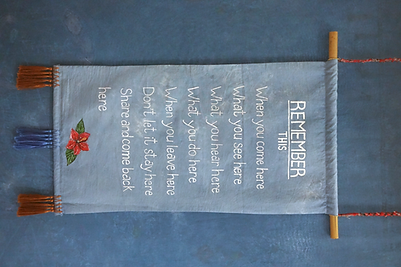
My final work, memory as a site of reconstruction, is an immersive experience that viewers become a part of upon entering. This house, made entirely of decorative indigo-dyed textiles, is adorned with gold trimmings and tassels. Made of different shades of blue, it stands on tile-printed linoleum flooring that disintegrates across the exhibition floor, hinting at the unseen parts of the house. The uncovered area, the veranda, is slightly framed by white decorative blocks used to enclose a seating area for visitors to interact with the work. Inside, inspired by how they decorated their homes, are a Jamaican scroll, vintage wooden and bamboo furniture, and doilies that hold ceramic pots, bronze masks, decorative bronze regalia, glass casts of the woodblock used in the making of the textile, and a bronze pot serving as an artifact of our existence.
Standing tall outside the house are two wooden figures representing my grandmothers. I found the figures in the wood grains and brought them to life with painted skin, lips, limbs, etc, enveloped in the textiles of my ancestors. The style is of my own invention and of the present, as opposed to the structure and sculptures in the interior, which reference cultural objects and homes.

A book that held great significance to the theory of this work is “belonging: a culture of place” by bell hooks. In it, she speaks about her journey of leaving home to find it elsewhere, but returning because the people, the land, and the culture were home. She also speaks about the Great Migration of Black Americans and how that affected their connection to land and community. As hooks said, “To bear the burden of memory, one must willingly journey to places long uninhabited, searching the debris of history for traces of the unforgettable, all knowledge of which has been suppressed.” Other books include Sarojini Lewis, “A Shift of Identity - Visual of Migrant Women: Situating the archive through a contemporary lens” and Christel Vesters, “Interwoven Histories - Contemporary Art, Migratory Narrative and Textiles “. Both had a focus on the use of indigo, my main pigment, across different cultures, the importance of textiles in trade and migration, and their role in archiving- “inseparable from the fabric of history”- Vesters.
“Reconstructing an archaeology of memory makes return possible, the journey to a place we can never call home…” bell hooks. A caring home is often like going back in time, with textiles serving as an archive. Memory as a site of reconstruction is a reflection of our past and present in the diaspora. A manifestation of our curiosity about our ancestors and our need to reconnect and belong when home doesn't feel like home. This piece is a reclamation of memories constructed through learning about traditional crafts, usually passed down generationally I have sought out through other means. Inspired by the aesthetics of my Afro-Jamaican and Indo-Jamaican grandmothers' homes, this installation references the aesthetic inheritance passed down through generations. It magnifies the ability of women to make a house a living space, a home, through beautifying.


The processes used, as mentioned, are of major importance to the work. The exterior of the house was created using multiple textile-making processes such as kalamkari, a hand-painted, block-printing technique from India, and Adire, an indigo resist-dyeing technique using folded cloth, tied thread, and painted cassava paste from Nigeria. Using the indigo dyeing process in the creation of the work was due to its multi-rootedness - indigenous all over the world, with a role in transatlantic trade. Within this home, I have made my own valuables that are artifacts of the people. My pottery fuses ceramic 3D printing with traditional West African and Indian pottery styles and textile motifs prominent in Nigeria, such as Okene, Akwete, and Adire, Ghanaian Kente, Chintz from India, and the Jamaican Bandana. This red bandana fabric, seen throughout the work, was originally from Madras (Chennai), India, but was brought to the Caribbean by the British during slavery. Enslaved Africans and Indian Indentured Servants were required to wear it, but African women were forced to use it to cover their hair by plantation owners due to discrimination and to maintain control. It has now become our symbol of resilience and pride in our national identity. Finally, the bronze pieces in the work are inspired by Ghanaian gold regalia and Nigerian bronze masks using lost-wax casting. The sense of home was created with the synthetic flowers I painted and the vintage objects, like handmade doilies and furniture I refurbished.
This body of work is an investigation of identity politics in Jamaica and the wider diaspora. It references my family and our home, but also things I have no direct connection to that hold significance. The objects turned sculptures were once used in rituals or during traditional practices, with the motifs and the craftsmanship used to make them passed down generationally. I am, however, engaging with them from an outsider's perspective, as this ancestral thread of knowledge was cut many generations ago. With colonialism came assimilation, and ways of life changed. Some things stayed, but the majority were combined, responding to a new society and culture. To me, this work is unique in its creation because many Jamaicans identify solely with Jamaican identity. There is a willful ignorance and distancing due to shame of having ancestors who were enslaved and taken advantage of. It’s also amplified by Western narratives that deem Africans and Indians as primitive and exotic, influencing our society. They therefore don’t see the need to connect with or claim our ancestors. I, however, have chosen to embody them using photography, placing myself as the vessel that houses them. The images of myself in the house are inspired by images taken during colonial times to exoticize enslaved Africans and Indian indentured servants for postcards to encourage Europeans to occupy the land.
This body of work is research that informs Jamaicans of our past and present identities, amplifying the beauty we come from. There is no shame in owning the story of our existence.
_edited.jpg)


oil paint, fabric, synthetic hair, bronze, beaded accessories on Baltic birch wood, 215 x 38 cm

oil paint, fabric, synthetic hair, bronze, beaded accessories on Baltic birch wood 220 x 37.7cm

jesmonite casts of woodblock carved by artist
oil paint, fabric, synthetic hair, bronze, beaded accessories on Baltic birch wood, 215 x 38 cm